
What Is a Not-for-Profit?

Posted on Categories Uncategorized  Leave a comment on What Is a Not-for-Profit?

When people hear the term not-for-profit, they often assume it simply means “an organization that doesn’t make money.” In reality, a not-for-profit is a specific legal structure, with distinct benefits, responsibilities, and limitations under Canadian law.

Understanding what a not-for-profit is—and how it differs from a traditional for-profit corporation—can help founders, boards, and community groups choose the right structure from the outset.
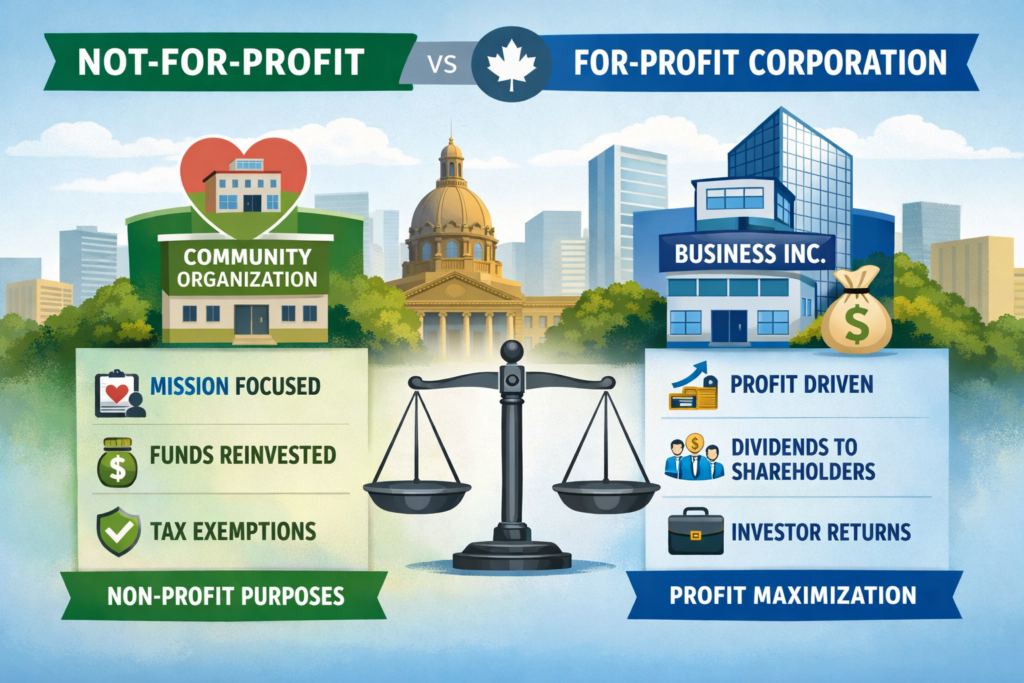
A Not-for-Profit Is a Corporation

At its core, a not-for-profit organization (often abbreviated as “NFP”) is a corporation. In Alberta, not-for-profits are commonly incorporated under the Societies Act or, at the federal level, under the Canada Not-for-profit Corporations Act.

Like any corporation, a not-for-profit:

  • Is a separate legal entity from its members or directors
  • Can enter into contracts
  • Can own property
  • Can sue and be sued
  • Provides limited liability protection for its directors and members (subject to statutory duties and exceptions)

This corporate structure allows a not-for-profit to operate with continuity, credibility, and legal protection—features that are often essential for organizations engaging with donors, governments, and the public.

How Not-for-Profits Differ from For-Profit Corporations

While not-for-profits and for-profit corporations share the same foundational concept of incorporation, they differ in purpose, profit distribution, and governance.

1. Purpose

A for-profit corporation exists primarily to generate profit for its shareholders. A not-for-profit, by contrast, is organized for a non-commercial purpose, such as:

  • Charitable or philanthropic activities
  • Social, cultural, or community objectives
  • Professional, recreational, or trade associations
  • Advocacy or public-interest work

In Canada, the law requires that a not-for-profit’s activities align with its stated non-profit purposes.

2. Profit and Distribution

A not-for-profit can earn revenue and even generate a surplus. What it cannot do is distribute profits to members, directors, or officers.

Any surplus must be reinvested into the organization’s purposes. This is one of the defining legal features separating not-for-profits from for-profit corporations, where dividends and shareholder distributions are central.

3. Ownership and Control

For-profit corporations are owned by shareholders. Not-for-profits do not (usually) have shareholders. Instead, they may have members, who typically elect the board of directors and help oversee the organization’s mission. Control is mission-driven rather than equity-driven.

4. Tax Treatment

Not-for-profits may be eligible for certain tax advantages under Canadian tax law, such as income tax exemptions, depending on their activities and structure. Some not-for-profits may also qualify for registered charity status, which brings additional benefits—and additional compliance obligations.

Not all not-for-profits are charities, and not all tax exemptions are automatic. Careful structuring and ongoing compliance are essential.

Why Choose a Not-for-Profit Structure?

A not-for-profit structure may be appropriate where:

  • The primary goal is mission-driven, not profit-driven
  • Funding will come from grants, donations, membership fees, or public sources
  • Public trust, transparency, and accountability are important
  • The organization needs legal continuity beyond its founders
  • Profit distribution would undermine credibility or legal eligibility for funding

In Alberta and across Canada, many community organizations, industry associations, sports clubs, and advocacy groups rely on the not-for-profit model to operate effectively while maintaining public confidence.

Not the Right Fit for Every Organization

A not-for-profit is not simply a “better” or “cheaper” alternative to a for-profit corporation. It comes with:

  • Governance obligations
  • Restrictions on how money can be used
  • Reporting and compliance requirements
  • Limitations on restructuring or winding up assets

For organizations intending to generate profits for founders or investors, a traditional for-profit corporation is usually the more appropriate choice.

Choosing the Right Structure

The decision between a not-for-profit and a for-profit corporation should be made early—and deliberately. The structure you choose affects governance, taxation, fundraising, liability, and long-term flexibility.

Legal advice at the incorporation stage can help ensure that your organization’s structure aligns with its goals, funding model, and legal obligations under Alberta and Canadian law.

Why Incorporate Your Business in Alberta?

Posted on Categories Uncategorized  Leave a comment on Why Incorporate Your Business in Alberta?

As a business owner in Alberta, you’ve likely poured countless hours into building your venture. But have you considered taking the next step and incorporating it? Incorporation isn’t just for big corporations—it’s a strategic move that can protect your personal assets, optimize your taxes, and set your business up for long-term success. At Chad Graham Law, we help entrepreneurs like you navigate these decisions.

In this post, we’ll explore the key reasons to incorporate your business under Alberta’s legal framework, drawing from the province’s Business Corporations Act and broader Canadian business laws.

Whether you’re running a startup in Edmonton’s tech scene or a family-owned operation in rural Alberta, understanding these benefits can help you make an informed choice. Let’s break it down.

What Is a Corporation? Understanding It as a Legal Person

At its core, a corporation is a separate legal entity—essentially, a “person” in the eyes of the law. Under Alberta’s Business Corporations Act, when you incorporate, your business becomes its own entity, distinct from you as the owner or shareholder. This means the corporation can own property, enter contracts, sue or be sued, and even incur debts independently.

What does this really mean for you? It shifts the business’s identity away from being tied solely to you as an individual. For instance, if you’re operating as a sole proprietorship or partnership, your personal name is often intertwined with the business. Incorporation allows you to brand it separately (e.g., “ABC Ventures Inc.”) and operate with a professional structure. This separation isn’t just cosmetic—it’s the foundation for the protections and advantages we’ll discuss next. In Alberta, you can choose provincial incorporation for local focus or federal for broader operations, but either way, it grants your business perpetual existence, even if ownership changes.

Legal Liability Protection: Shielding Your Personal Assets

One of the most compelling reasons to incorporate is the limited liability it provides. As a sole proprietor or partner, you’re personally on the hook for all business debts and legal issues. A lawsuit, unpaid supplier, or workplace accident could put your home, savings, or other personal assets at risk.

Incorporation changes that. Shareholders (often just you, if it’s a one-person operation) are generally not personally liable for the corporation’s obligations beyond their investment in shares. In Alberta, this is enshrined in the Business Corporations Act, which limits your exposure to what you’ve put into the company. Of course, there are exceptions—like if you personally guarantee a loan or engage in fraudulent activity—but for everyday risks, this “corporate veil” offers significant peace of mind.

Imagine a scenario: Your Alberta-based construction firm faces a claim for defective work. Without incorporation, creditors could come after your personal property. With it, they target the corporation’s assets first. This protection is especially valuable in high-risk industries common in Alberta, like oil and gas, agriculture, or retail. It’s not foolproof, but it’s a critical layer of defense that sole proprietors simply don’t have.

Tax Planning Flexibility: Optimizing Your Financial Strategy

Taxes can make or break a business, and incorporation opens up a world of flexibility not available to unincorporated entities. In Canada, including Alberta, corporations are taxed separately from individuals, often at lower rates for active business income.

For small businesses, the federal small business deduction can reduce the corporate tax rate to as low as 9% on the first $500,000 of active income (combined federal and provincial rates in Alberta are around 11% for 2023, but always check current rates). This is a stark contrast to personal income tax rates, which can climb over 40% for higher earners. By leaving profits in the corporation, you can defer personal taxes until you withdraw them as dividends or salary, allowing for better cash flow management.

Alberta’s lack of provincial sales tax (beyond GST) and competitive corporate rates make it an attractive place to incorporate. You can also split income among family members as shareholders, use holding companies for investment income, or claim deductions for business expenses more strategically. Tools like the Scientific Research and Experimental Development (SR&ED) tax credits, popular in Alberta’s innovation sectors, are easier to access as a corporation. Work with a tax advisor to tailor this, but incorporation often means paying less tax overall and reinvesting more into growth.

Succession Planning and Sale Advantages: Building for the Future

Thinking about the long game? Incorporation makes it easier to plan for succession, whether passing the business to family or selling it outright. Shares in a corporation can be transferred seamlessly, without disrupting operations—unlike sole proprietorships, where the business essentially dissolves upon the owner’s exit.

In Alberta, this structure supports smooth estate planning. For example, you can issue different classes of shares to control voting rights while distributing ownership. And when it’s time to sell, buyers prefer corporations for their established structure and limited liability.

A standout benefit is the Lifetime Capital Gains Exemption (LCGE), a federal provision that lets you exempt up to $1,016,836 (as of 2024, indexed annually) in capital gains when selling shares of a qualified small business corporation. To qualify, the corporation must meet criteria like being Canadian-controlled and using at least 90% of assets in active business. In Alberta’s entrepreneurial landscape—from Edmonton startups to Fort McMurray energy firms—this can translate to massive tax savings. Imagine selling your business and keeping over a million dollars tax-free—incorporation is key to unlocking this.

Is Incorporation Right for You?

Incorporating in Alberta offers robust protections and opportunities, but it’s not for every business. There are upfront costs (around $300-$500 for registration, plus legal fees), ongoing compliance (annual returns, filings), and potential complexity. If your operation is small and low-risk, a sole proprietorship might suffice. However, for growth-oriented ventures, the advantages often outweigh the drawbacks.

At Chad Graham Law, we’re here to guide you through the process, from deciding on federal vs. provincial incorporation to drafting articles of incorporation. Contact us today for a consultation tailored to your Alberta business needs. Let’s turn your hard work into a protected, thriving legacy.

Disclaimer: This post is for informational purposes only and not legal advice. Consult a qualified lawyer for personalized guidance.

Legacy Giving: How to Support Your Church or Favourite Charity – and Potentially Leave More for Your Family Too

Posted on Categories UncategorizedTags , , , ,   Leave a comment on Legacy Giving: How to Support Your Church or Favourite Charity – and Potentially Leave More for Your Family Too

What is Legacy Giving?

Legacy giving (sometimes called “planned giving”) simply means including a charitable gift in your overall estate plan. This can be a specific bequest in your Will, naming a charity as beneficiary of an insurance policy or RRSP/RRIF, or donating assets such as publicly-traded stocks, mutual funds, or even real estate during your lifetime or through your estate.

Key Tax Advantages Under Canadian Law

When structured properly, gifts of certain appreciated assets to registered charities (including most churches and ministries) can offer significant tax benefits:

  • No capital gains tax on appreciated publicly-traded securities (stocks, bonds, mutual funds/ETFs) or certain real property donated directly to a charity – the gain is completely exempt (Income Tax Act s. 38(a.1) & s. 118.1).
  • A charitable donation tax credit (or deduction if donated by your estate) based on the full fair-market value of the gift – often worth 40–54% of the gift’s value depending on your province and income level.
  • The combined effect frequently allows you to give substantially more to charity than if you sold the asset, paid tax, and then donated the after-tax cash – all while leaving the same (or more) net inheritance for your family.
  • Donations made through your Will are deemed to be made in the year of death, which can offset taxes on RRSP/RRIF withdrawals, capital gains, and other terminal-return income.

A Simple Example (General Illustration Only)

Imagine you own publicly-traded shares now worth $100,000 (original cost $20,000). If sold, approximately $40,000–$50,000 in capital gains tax might be payable (depending on your bracket). After tax, you would have roughly $50,000–$60,000 left to give.

By donating the shares directly to your church or charity instead:

  • $0 capital gains tax
  • Charity receives the full $100,000
  • You (or your estate) receive a donation receipt for $100,000 → a tax credit worth roughly $40,000–$54,000 (covering, if set off on another tax event, up to the whole cost of the gift!)

Result: Your favourite ministry receives 40–70% more, and your family’s overall tax burden is reduced – often leaving them better off than if the shares were sold and the cash divided among heirs.

Important Notes

This information is for general educational purposes only and is not legal or tax advice. Every situation is unique. Tax rules are complex and change periodically. The benefits described apply only to certain types of property and registered charities.

Please consult a qualified wills & estates lawyer and a knowledgeable accountant or financial advisor before implementing any legacy giving strategy. I would be honoured to help you explore how this could fit into your estate plan.

Helpful Resources

If you’d like to talk about how legacy giving could work in your family’s situation, feel free to reach out – I’m always happy to have an initial no-obligation conversation.

Steps to Update Your Estate Planning

Posted on Categories Estate PlanningTags , , ,   Leave a comment on Steps to Update Your Estate Planning

Life changes, and your estate plan should too. Whether it’s a codicil for your Will or a fresh Personal Directive or Enduring Power of Attorney, we’re here to help Edmonton residents (and other Albertans) protect their legacy.

Ready to Update Your Estate Plan?

Ready to make changes? Here’s a straightforward guide to updating your estate planning documents in Alberta:

  1. Review Your Current Documents: Pull out your existing Will, PD, and EPA. Read through them to identify what needs updating. If you’re unsure, an Edmonton estate planning lawyer can review them with you and spot potential issues.
  2. Identify Your Goals: Are you adding a new beneficiary? Changing an executor or agent? Clarifying healthcare wishes? Knowing your goals helps streamline the process.
  3. Consult a Lawyer: Alberta’s estate laws have specific requirements, especially for Wills, PDs, and EPAs. A lawyer can guide you on whether a codicil or new document is best and ensure everything is legally sound.
  4. Draft and Sign Properly: Whether it’s a codicil or a new document, it must be signed and witnessed according to Alberta law. For example, a Will or codicil typically needs two witnesses who aren’t beneficiaries and one of those witnesses needs to have an affidavit commissioned.
  5. Store Safely and Share: Once updated, store your documents securely (like in a safety deposit box or with your lawyer) and let your executor or agents know where to find them.

Common Mistakes to Avoid

Updating estate planning documents can feel overwhelming, but avoiding these pitfalls can save time and stress:

  • DIY Changes: Scribbling changes on your Will or PD won’t hold up in Alberta courts. Always follow proper legal processes.
  • Forgetting Related Documents: If you update your Will, check if your PD or EPA needs tweaking too. Consistency across your estate plan is key.
  • Not Consulting a Lawyer: Alberta’s laws are specific, and a small oversight could invalidate your changes. A lawyer ensures your documents are ironclad.

Why Work with an Edmonton Estate Planning Lawyer?

Updating your Will, PD, or EPA isn’t just about paperwork—it’s about peace of mind. At Chad Graham Law, we take the time to listen to your goals and tailor your estate plan to fit your life. Whether you’re considering a codicil for a small Will change or need to redo your PD or EPA, we’re here to make the process smooth and stress-free. As an Edmonton estate planning law firm, we know Alberta’s estate laws inside and out, ensuring your wishes are clear and legally binding.

How to Update Your Will or Estate Planning Documents in Alberta

Posted on Categories Estate PlanningTags ,   Leave a comment on How to Update Your Will or Estate Planning Documents in Alberta

Life is full of changes—new family members, shifting financial situations, or simply a change of heart about how you want your legacy to look. If you’re wondering, “How do I update my Will or other estate planning documents in Edmonton?” you’re not alone. 

As an Edmonton estate planning lawyer, I often chat with clients who want to ensure their plans stay current. Let’s walk through the process of how you can update your Will, Personal Directive (PD), or Enduring Power of Attorney (EPA) in a way that’s clear, practical, and tailored to Alberta law.

Continue reading “How to Update Your Will or Estate Planning Documents in Alberta”

Why Every Albertan Should Craft a Will: Unlock Peace of Mind with Estate Planning

Posted on Categories Uncategorized  Leave a comment on Why Every Albertan Should Craft a Will: Unlock Peace of Mind with Estate Planning

Imagine this: you’ve worked hard your whole life to build a home, save for your family, and create a legacy you’re proud of. Now, picture a future where your wishes aren’t honored because you never put them in writing.

It’s a scenario no one likes to think about—but it happens more often than you’d expect. In Alberta, having a Will isn’t just a good idea; it’s a vital step toward ensuring your loved ones are cared for and your legacy is protected. At its core, a Will offers something invaluable: peace of mind.

If you’re wondering whether you really need a Will or how to get started, you’re not alone. Many Albertans put off estate planning, assuming it’s only for the wealthy or the elderly. The truth? Everyone over 18 in Alberta can—and should—have a Will. Let’s explore why this simple document is so powerful and how a lawyer can help you craft one with confidence.

Continue reading “Why Every Albertan Should Craft a Will: Unlock Peace of Mind with Estate Planning”

Understanding Enduring Power of Attorney in Alberta: Your Path to Peace of Mind

Posted on Categories Estate AdministrationTags ,   Leave a comment on Understanding Enduring Power of Attorney in Alberta: Your Path to Peace of Mind

An Enduring Power of Attorney (EPA) is a crucial legal document that allows you to appoint someone you trust to manage your financial affairs if you become incapacitated. This document remains effective even if you lose mental capacity, ensuring your financial matters are handled according to your wishes.

Continue reading “Understanding Enduring Power of Attorney in Alberta: Your Path to Peace of Mind”

The Importance of a Good Probate Lawyer 

Posted on Categories UncategorizedTags , , , ,   Leave a comment on The Importance of a Good Probate Lawyer 

Navigating the Intricacies of Estate Administration

As we journey through life, it’s essential to plan for the future, ensuring that our loved ones are cared for and our wishes are respected. The legal landscape can be complex, and for most people is unfamiliar territory. You can certainly learn to navigate it. But when it comes to administering an estate, the expertise of a good probate lawyer and accountant can be invaluable partners.

Continue reading “The Importance of a Good Probate Lawyer “

What Does My Probate Lawyer Do?

Posted on Categories Estate Administration, Uncategorized  Leave a comment on What Does My Probate Lawyer Do?

Being named an executor in the deceased’s will can feel overwhelming. What do you need to know? What needs to be done? What should you do first? Where can you turn for help? 

Even as a law school graduate, I quickly discovered that working through the administration of the estate of a loved one for the first time was challenging. A Probate lawyer brings knowledge and experience to help you navigate through the process from beginning to end. 

Continue reading “What Does My Probate Lawyer Do?”

Why Every Parent in Alberta Should Consider Making a Will

Posted on Categories Uncategorized  Leave a comment on Why Every Parent in Alberta Should Consider Making a Will

Have you ever wondered what would happen to your children if you were no longer around to care for them? As parents, we naturally want to ensure our children are safe, loved, and well-cared for, no matter what the future holds. One of the most important steps you can take to secure your children’s future is to create a will that designates a guardian for them. This simple yet powerful document can bring immense peace of mind, knowing that your children will be in the care of someone you trust.

Continue reading “Why Every Parent in Alberta Should Consider Making a Will”