
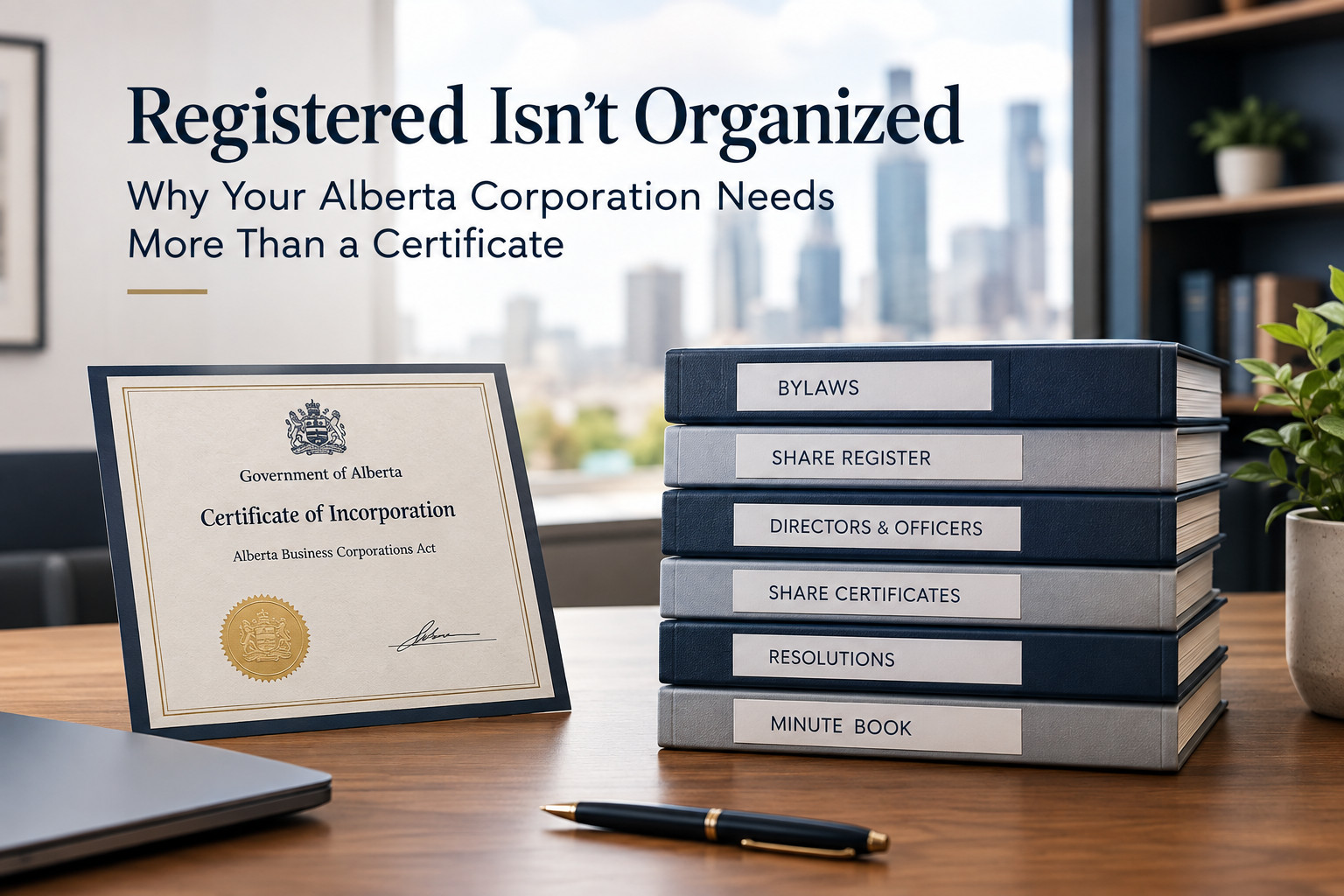
Every so often, someone sends me a certificate of incorporation and a question: “I incorporated my company last year. Now the bank wants to see my minute book. What’s a minute book?”
It’s a good question. In most of these cases, the corporation was registered but never organized. Those are two different things, and the difference usually shows up at the worst possible time.
Registering vs. Organizing
Registering is what a registry agent or online service does: a name search, Articles of Incorporation, and notices of the corporation’s address and directors. Alberta then issues a certificate of incorporation, and the corporation exists.
Think of it this way. You run a business. You invoice a client, stamp the invoice “PAID,” and file it away. What’s missing? The money. Your records say you’ve been paid, but no payment ever happened.
Registering without organizing works the same way. The public record says a corporation exists, but there’s nothing inside it. No shares have been issued. There are no shareholders, no bylaws, and no officers. The paperwork says one thing, and the reality says another.
The Business Corporations Act requires the directors to meet after incorporation. At that meeting they may make bylaws, adopt forms of security certificates and corporate records, authorize the issue of shares, appoint officers, appoint an auditor, and make banking arrangements (RSA 2000, c B-9, s 104(1)). That is the organizing step.
What an Organized Corporation Has
- Bylaws
- Organizational resolutions of the directors and shareholders
- Share subscriptions and share certificates
- A securities register
- A register of directors and officers
- A register of individuals with significant control
- A minute book that holds all of it
Registry agents and online services stop at registration. They can’t give legal advice, so they can’t tell you who should hold shares, which share classes to authorize, or how the corporation should be governed.
Why It Matters
Ownership. If no shares were issued, the corporation has no shareholders. Shareholders elect directors, so it’s unclear who the directors are or what authority they have.
Tax planning. With one class of shares and one share issued, you can’t easily sell 15% to a key employee. You also generally can’t pay a dividend to one shareholder without paying the others proportionately. The right share structure, built alongside your accountant, gives you flexibility on dividends, control, and future ownership changes.
Bank financing. Lenders typically require a lawyer’s opinion that the corporation is duly incorporated and organized. No records, no opinion. The work then gets done in a rush before closing, usually at a higher cost.
CRA audits. Dividends paid on shares that were never properly issued can cause problems on audit, for the corporation and for the people who received them.
Sales and estates. A buyer’s lawyer will go through your minute book. When a shareholder dies, the executor has to prove what the deceased owned. Missing records slow both down and cost more to fix than to do right the first time.
Already Registered? It Can Be Fixed
Most unorganized corporations can be cleaned up. The approach depends on what has happened since registration: dividends paid, owners added or removed, annual returns filed or missed. The sooner it’s addressed, the easier it is.
One Process, Done Once
At Chad Graham Law, registering and organizing are one process: articles, share structure, bylaws, resolutions, registers, and a complete minute book. We also talk through who should own what, and why.
Starting a business, or worried your corporation was never organized? Reach out to discuss your options (CONTACT CHAD)