
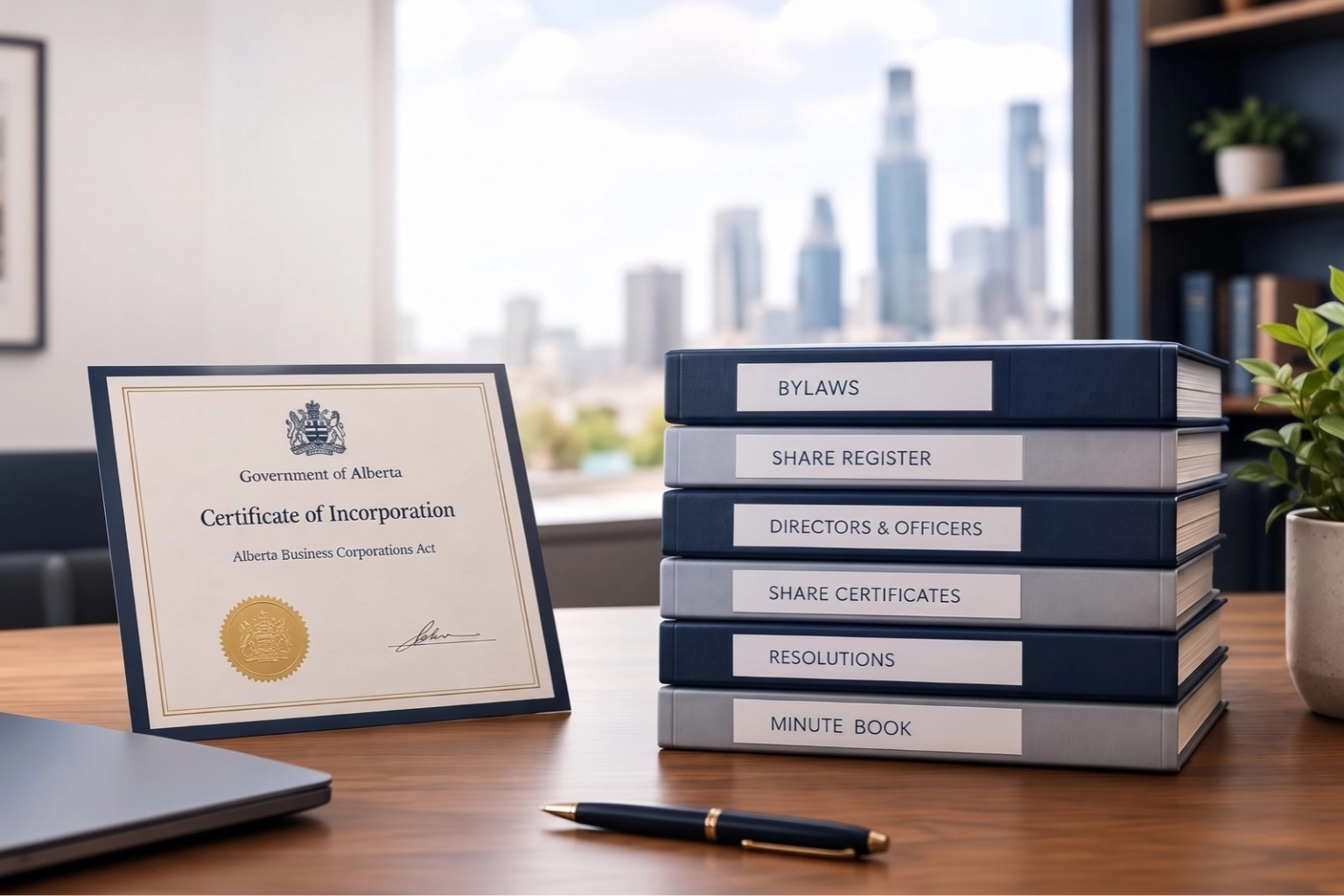
Every so often, someone sends me the certificate of incorporation Alberta issues to new businesses, along with a question: “I incorporated my company last year. Now the bank wants to see my minute book. What’s a minute book?”
A minute book is the corporation’s official record: its articles, bylaws, resolutions, share records, and registers. Banks, buyers, and the CRA ask for it to confirm who owns and controls the company, as legally required by section 20 of Alberta’s Business Corporations Act (ABCA).
Many business owners assume company incorporation in Alberta ends when the certificate arrives. But in most of these cases, the corporation was registered but never organized. Those are two different things, and the gap usually surfaces when a bank, buyer, or auditor asks for records.
Registering vs. Organizing Your Alberta Corporation
Alberta Incorporate
Registering is what a registry agent or online service does: a name search, filing the articles of incorporation Alberta requires, plus notices of the corporation’s address, directors, and (where required) agent for service. The province then issues a certificate of incorporation, and the corporation exists.
The corporation legally exists the day the certificate is issued, but there’s nothing inside it. No shares have been issued, so there are no shareholders and, on paper, nobody owns it. Bylaws and officers are usually missing too.
Alberta’s Business Corporations Act requires an organizational meeting of directors after incorporation, which in small corporations is usually done by signed written resolution. At that meeting they may make bylaws, adopt forms of security certificates and corporate records, authorize the issue of shares, appoint officers, appoint an auditor, and make banking arrangements (RSA 2000, c B-9, s 104(1)). That is the organizing step.
Inside Your Minute Book: What an Organized Corporation Needs
- Bylaws
- Organizational resolutions of the directors and shareholders
- Share subscriptions and share certificates
- A securities register
- A register of directors and officers
- A minute book that holds all of it
Registry agents, and many basic online packages, stop at registration. They can’t give legal advice, so they can’t tell you who should hold shares, which share classes to authorize, or how the corporation should be governed.
5 Costly Risks of an Unorganized Corporation
Ownership & Voting Rights
If no shares were issued, the corporation has no shareholders. The directors named at registration stay in office, but with no shareholders, no one can elect a new board, confirm bylaws, or approve major decisions. Under section 106(2) of the ABCA, the first directors named during registration only legally hold office until the first meeting of shareholders.
Tax Planning & Dividends
Even corporations that did issue shares often have one class and one share. With one class of shares, bringing in a key employee means giving them the same voting and dividend rights you have. You also generally can’t pay a dividend to one shareholder without paying other holders of the same class proportionately. The right share structure, built alongside your accountant, gives you flexibility on dividends, control, and future ownership changes, subject to the tax on split income (TOSI) rules, which can tax dividends paid to family members at the top rate. If there are two or more owners, pair the share structure with a shareholder agreement.
Bank Financing & Commercial Loans
For larger commercial loans—typically those over $250,000 or those backed by real estate or equipment—lenders often require a lawyer’s opinion that the corporation is duly incorporated and organized, and without records, the lawyer can’t give one. The work then gets done in a rush before closing, usually at a higher cost. A proper organization at the time of incorporation generally costs between $1,200 to $1,500, whereas a rush minute book cleanup before a loan closing can easily exceed $2,500 to $5,000 depending on how much history needs fixing.
CRA Audits & Recharacterization
Dividends paid on shares that were never properly issued can cause problems on audit, for the corporation and for the people who received them. The CRA can recharacterize the payment as a “shareholder appropriation” under section 15(1) of the Income Tax Act. This means the payment becomes fully taxable as personal income without the benefit of the dividend tax credit, and it remains non-deductible for the corporation.
Business Sales & Estate Planning
A buyer’s lawyer will go through your minute book. When a shareholder dies, the executor has to prove what the deceased owned as part of probate. Missing records slow both down and cost more to fix than to do right the first time. A will that covers your shares makes the estate side easier.
Missing Corporate Records? How We Fix It
Most unorganized corporations can be cleaned up. In the cleanups I’ve handled, the only ones that get incredibly difficult are when a founding “partner” left the business years prior, but because shares were never formally issued or cancelled, it is legally ambiguous whether they still own half the company.
The approach depends on what has happened since registration: dividends paid, owners added or removed, annual returns filed or missed. Missed filings are especially dangerous; if you fail to file your annual corporate returns, the Registrar can strike your corporation from the active registry and dissolve it under section 213 of the ABCA.
Alberta Incorporation Done Right: One Process, Done Once
At Chad Graham Law, proper Alberta incorporation means registering and organizing happen as one process: articles, share structure, bylaws, resolutions, registers, and a complete minute book. We also talk through who should own what, and why.
Starting a business, or worried your corporation was never organized? Reach out to discuss your options.
This post is general information, not legal advice. For advice about your corporation, speak with a lawyer.