
Most Albertans, when they think about estate planning, think about a Will.
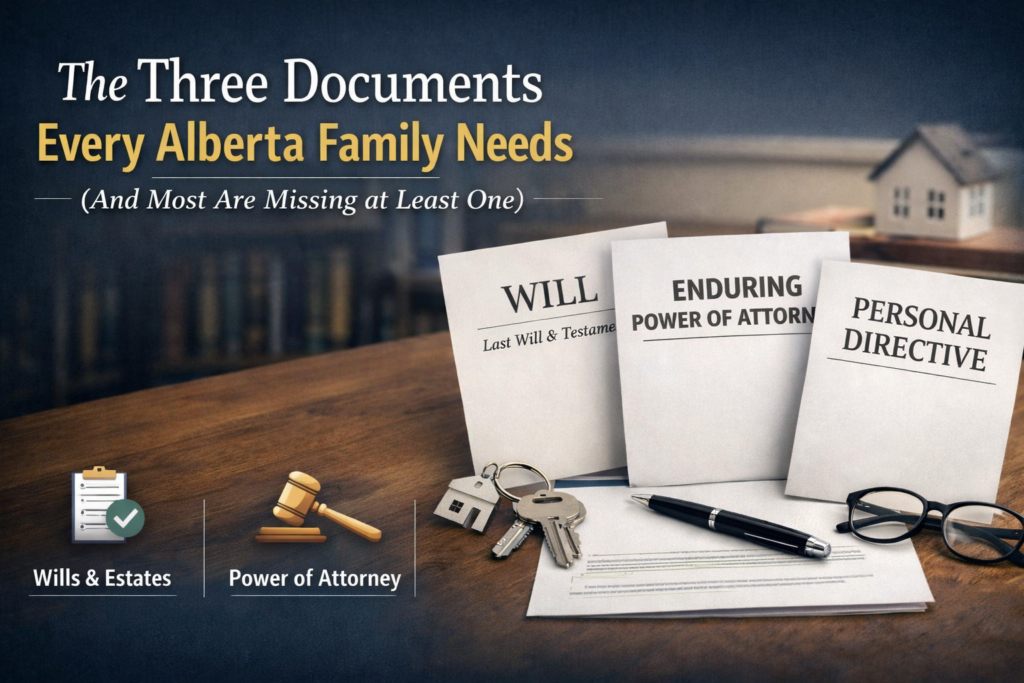
That instinct is right. A Will is the foundation. But it is only one of three documents that every Alberta adult should have in place — and the other two are often missing, sometimes with serious consequences for the families left to manage the gap.
This article explains what each document does, why each one matters, and what happens when one of them isn’t there.
The Three Documents
A Will governs what happens to your assets after you die. An Enduring Power of Attorney governs who manages your finances if you lose capacity during your lifetime. A Personal Directive governs who makes your healthcare and personal care decisions if you cannot make them yourself.
Each document addresses a distinct situation. Together, they cover the full range of circumstances that estate planning is designed for. Separately, each one leaves a gap.
1. Your Will: Directing Your Estate After Death
A Will is a legal document that records your instructions for what happens to your property, your debts, and your dependants after you die. In Alberta, Wills are governed primarily by the Wills and Succession Act, SA 2010, c W-12.2.
Your Will names an executor — the person responsible for administering your estate, paying your debts, and distributing your assets according to your instructions. It names beneficiaries — the people or organizations who receive what you leave behind. And if you have minor children, it names a guardian — the person you have chosen to raise them if you cannot.
Without a Will, Alberta’s intestacy rules determine how your estate is distributed. Those rules follow a statutory formula. The formula does not know that you wanted your business partner bought out before the estate was distributed. It does not know that your adult children from a first marriage have different needs than your current spouse. It does not account for the charity you intended to remember, or the family member you intended to exclude.
A Will gives you control over those decisions. The absence of one transfers that control to legislation.
When to review your Will: A Will should be reviewed after any significant life change — marriage or separation, the birth or adoption of a child, the death of a named executor or beneficiary, a significant acquisition or disposition of assets, or the start or sale of a business. In Alberta, marriage does not automatically revoke a prior Will. If your circumstances have changed since you last signed your Will, your documents may no longer reflect your wishes.
2. An Enduring Power of Attorney: Planning for Incapacity
An Enduring Power of Attorney (EPA) is a legal document that appoints a person — your attorney — to manage your financial and legal affairs if you become unable to do so yourself.
The word “enduring” is significant. An ordinary power of attorney ceases to be effective if the person who granted it loses mental capacity. An enduring power of attorney is specifically designed to survive incapacity — which is precisely when you need it most.
An EPA can be structured to take effect immediately upon signing, or to come into effect only upon a triggering event such as a medical declaration of incapacity. The scope can be broad — covering all financial and legal decisions — or limited to specific matters.
The most important thing to understand about an EPA: You can only sign one while you have legal capacity. If you wait until a health crisis has already occurred, it is too late. At that point, a family member who needs authority to manage your affairs must apply to the Court of King’s Bench of Alberta for a Trusteeship Order under the Adult Guardianship and Trusteeship Act, SA 2008, c A-4.2. That process takes time, costs money, and places the decision in a court’s hands rather than yours.
An EPA is not about giving up control while you are well. It is about choosing, deliberately and on your own terms, who holds authority if you cannot.
3. A Personal Directive: Your Voice in Healthcare Decisions
A Personal Directive (PD) is a legal document that records your wishes regarding personal matters — primarily healthcare decisions, treatment preferences, and living arrangements — and appoints a person to make those decisions on your behalf if you are unable to do so.
Personal Directives in Alberta are governed by the Personal Directives Act, RSA 2000, c P-6.
Without a Personal Directive, decisions about your healthcare default to whoever your attending physician identifies as your nearest available adult family member, following a statutory priority list. That person may or may not be who you would choose. They will be making significant, sometimes irreversible decisions about your care with no written record of your values, preferences, or wishes to guide them.
The practical consequences of a missing Personal Directive are not always dramatic — sometimes the statutory process works reasonably well. But in families where there is any disagreement, any distance, or any complexity in relationships, the absence of a Personal Directive can turn a medical crisis into a family conflict.
A Personal Directive does not have to be a lengthy document. For most people, it addresses a few core questions: Who do you trust to make these decisions? What values should guide them? Are there treatments you would or would not want in specific circumstances? The document gives those answers legal authority.
Putting It Together
A Will, an Enduring Power of Attorney, and a Personal Directive together constitute a complete basic estate plan for most Alberta adults. They are not documents reserved for the wealthy or the elderly. They are relevant to any adult who has people they care about, assets they have worked for, or preferences about their own care.
For most Alberta families, the process of getting all three documents in place is straightforward. At Chad Graham Law, we have built an online intake process that takes most clients approximately 15 minutes to complete. We prepare your documents, review them with you, and meet — in person or virtually — to sign.
If your situation involves more complexity — a blended family, a business interest, a family trust, or questions about how your estate plan integrates with your corporate structure — reach out directly (a contact form is available here). That is exactly the kind of planning we do (find out more about our services).
Ready to Get Started?
Our Online Will App makes estate planning straightforward. Answer a few guided questions, we prepare your documents, and you sign with confidence.
Most clients complete their intake in under 15 minutes. The rest is on us.
Chad Graham is a barrister and solicitor practicing estate planning and corporate-commercial law in Edmonton and Beaumont, Alberta. He is the founder of Chad Graham Law.