

Good estate planning is not complicated for most Alberta families. The documents are straightforward, the process is well-established, and the peace of mind that comes from having everything in order is genuine and lasting.
What is complicated is undoing the damage when those documents are missing, outdated, or incomplete — and that work happens at the worst possible time, when families are already managing grief.
After years of estate planning practice, and nearly a decade before that in pastoral ministry walking alongside families through loss, I have seen the same patterns appear repeatedly. Not because people are careless. Because life moves fast, and estate planning is easy to defer.
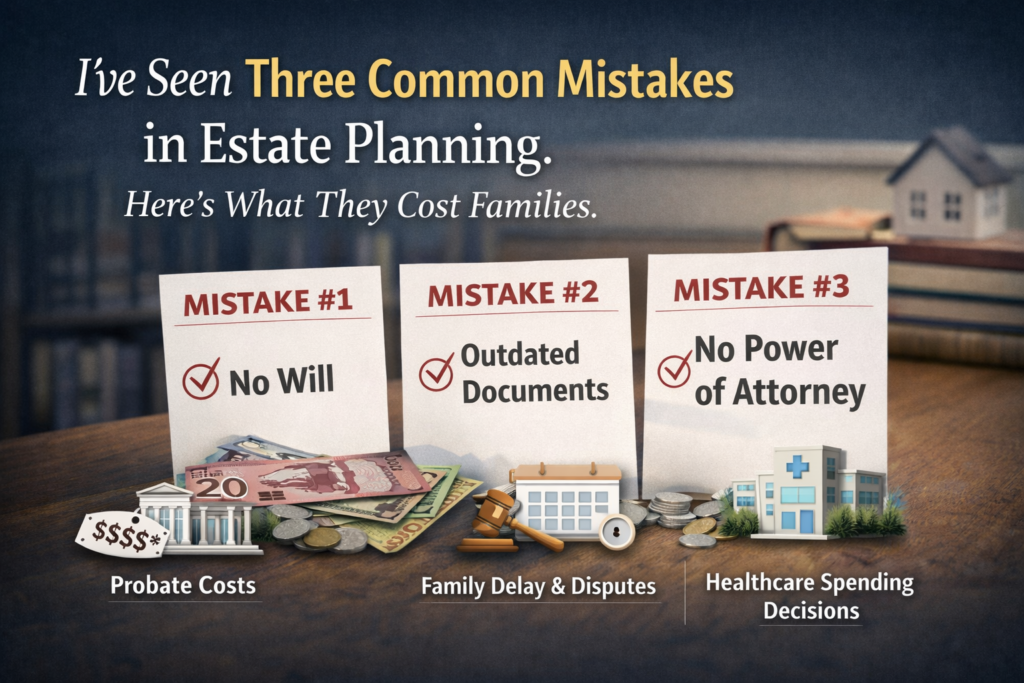
Here are the three mistakes I see most often, what they cost families, and how to address each one.
Mistake 1: No Personal Directive
Most Albertans who have thought about estate planning have a Will. Fewer have an Enduring Power of Attorney. A significant number have no Personal Directive at all.
A Personal Directive is the legal document that governs your healthcare and personal care decisions if you lose the capacity to make them yourself — whether through illness, serious injury, surgery, or cognitive decline. In Alberta, Personal Directives are governed by the Personal Directives Act, RSA 2000, c P-6.
Without a Personal Directive, those decisions fall to whoever your attending physician identifies as your nearest available adult family member, following the priority list set out in the legislation. That person may not be who you would choose. They will be making significant, sometimes irreversible decisions about your care with no written guidance from you.
What this costs families: I have seen families divide seriously over healthcare decisions made without a Personal Directive. Adult children with genuinely different views on what their parent would have wanted, no document to settle the question, and a care facility or hospital caught in the middle. These situations are painful in a way that is distinct from ordinary grief — because the conflict feels avoidable, and often is.
The fix: A Personal Directive does not have to be long or complex. For most people, it addresses a small number of core questions: who you trust to make these decisions, what values should guide them, and whether there are specific treatments you would or would not want. The document is typically a few pages. The conversation required to complete it thoughtfully takes less time than most people expect.
Mistake 2: A Will That Hasn’t Been Updated After a Major Life Change
A Will reflects your life as it was on the day you signed it. It does not update itself when your circumstances change.
The most common version of this mistake in my practice: a Will drafted years earlier that no longer reflects the person’s family, assets, or intentions. A second marriage. A business that didn’t exist when the Will was signed. Children or grandchildren born after the document was executed. A named executor who has since died or become estranged.
A point that surprises many Albertans: In Alberta, marriage does not automatically revoke a prior Will. This is different from the law in some other Canadian provinces, and it catches people off guard. A Will signed before a second marriage may remain legally valid after it — meaning the distribution it describes, which may not include a new spouse or reflect a blended family, could still govern the estate.
Alberta’s Wills and Succession Act, SA 2010, c W-12.2, does provide some protections for a surviving spouse or adult interdependent partner not adequately provided for in a Will — but those protections involve legal processes that your family should not have to navigate if a simple update would have addressed the issue.
What this costs families: At minimum, time and legal expense to address a distribution that doesn’t reflect the deceased’s actual wishes. At worst, genuine hardship for a surviving spouse or dependent who was not adequately provided for because the Will was never updated.
The fix: Review your Will any time something significant changes — marriage or separation, the birth or adoption of a child, the death of a named executor or beneficiary, a significant acquisition or disposition of assets, or the start or sale of a business. The review does not always result in a new Will. Sometimes a codicil addresses the issue. Sometimes no change is needed. But the review should be deliberate, not deferred indefinitely.
A general rule of thumb: if you have not looked at your Will in five years, look at it now.
Mistake 3: An Executor Who Has No Idea What They’re Walking Into
Naming someone executor in your Will gives them significant legal authority and significant legal responsibility. It does not give them any information.
The executor of an Alberta estate is responsible for locating and securing assets, notifying beneficiaries and creditors, managing financial accounts, potentially applying for a Grant of Administration through the Court of King’s Bench, addressing any business interests, filing terminal tax returns, and ultimately distributing the estate — all while navigating their own grief if the deceased was someone they loved.
Most named executors have never done this before. In my experience, most don’t know where the Will is stored, don’t have a list of accounts or assets, don’t know who the deceased’s accountant or financial advisor was, and have no idea whether there is outstanding debt, a pending legal matter, or a business interest that requires immediate attention.
What this costs families: Time, confusion, and expense at the worst possible moment. An estate that could be administered efficiently over several months can stretch significantly when the executor is starting from scratch — locating documents, tracking down accounts, trying to reconstruct the deceased’s financial picture from fragments.
The fix: Write a letter to your executor and keep it with your Will. It does not need to be formal. It should tell them where your important documents are stored, what financial accounts and assets exist, who your lawyer, accountant, and financial advisor are, whether there are any debts or ongoing obligations, and anything unusual about your estate that they should know.
Update this letter periodically. Tell your executor where to find it.
This document has no legal status. It is simply information. But in practice it is one of the most valuable things you can leave behind — because it turns an overwhelming task into a manageable one, and it does so at a moment when the people you love most need things to be manageable.
The Broader Point
None of these mistakes require complex solutions. A Personal Directive, a current Will, and a prepared executor are achievable for virtually every Alberta family — and the process of getting there is more straightforward than most people expect.
What they require is deciding to do it, and doing it before something happens.
At Chad Graham Law, we have built an intake process specifically designed to make estate planning easy. Most clients complete their initial intake online in about 15 minutes. We prepare your documents, review them with you, and meet to sign — in person near Edmonton or Beaumont, or virtually if that works better for you.
If your situation involves more complexity — a blended family, business interests, a family trust, or questions about how your estate integrates with your corporate structure — reach out directly (there is a contact form in the link above). That conversation is always worthwhile, and the first one is always without obligation.
Ready to Get Your Estate Plan in Order?
Our Online Will App makes it simple. Complete your intake in about 15 minutes, we prepare your documents, and you sign with confidence.
Start here → chadgrahamlaw.com/online-wills-app
Or reach out directly if you have questions. I am always happy to talk.
Chad Graham is a barrister and solicitor practicing estate planning and corporate-commercial law in Edmonton and Beaumont, Alberta. He is the founder of Chad Graham Law.