
When people hear the term not-for-profit, they often assume it simply means “an organization that doesn’t make money.” In reality, a not-for-profit is a specific legal structure, with distinct benefits, responsibilities, and limitations under Canadian law.
Understanding what a not-for-profit is—and how it differs from a traditional for-profit corporation—can help founders, boards, and community groups choose the right structure from the outset.
A Not-for-Profit Is a Corporation
At its core, a not-for-profit organization (often abbreviated as “NFP”) is a corporation. In Alberta, not-for-profits are commonly incorporated under the Societies Act or, at the federal level, under the Canada Not-for-profit Corporations Act.
Like any corporation, a not-for-profit:
- Is a separate legal entity from its members or directors
- Can enter into contracts
- Can own property
- Can sue and be sued
- Provides limited liability protection for its directors and members (subject to statutory duties and exceptions)
This corporate structure allows a not-for-profit to operate with continuity, credibility, and legal protection—features that are often essential for organizations engaging with donors, governments, and the public.
How Not-for-Profits Differ from For-Profit Corporations
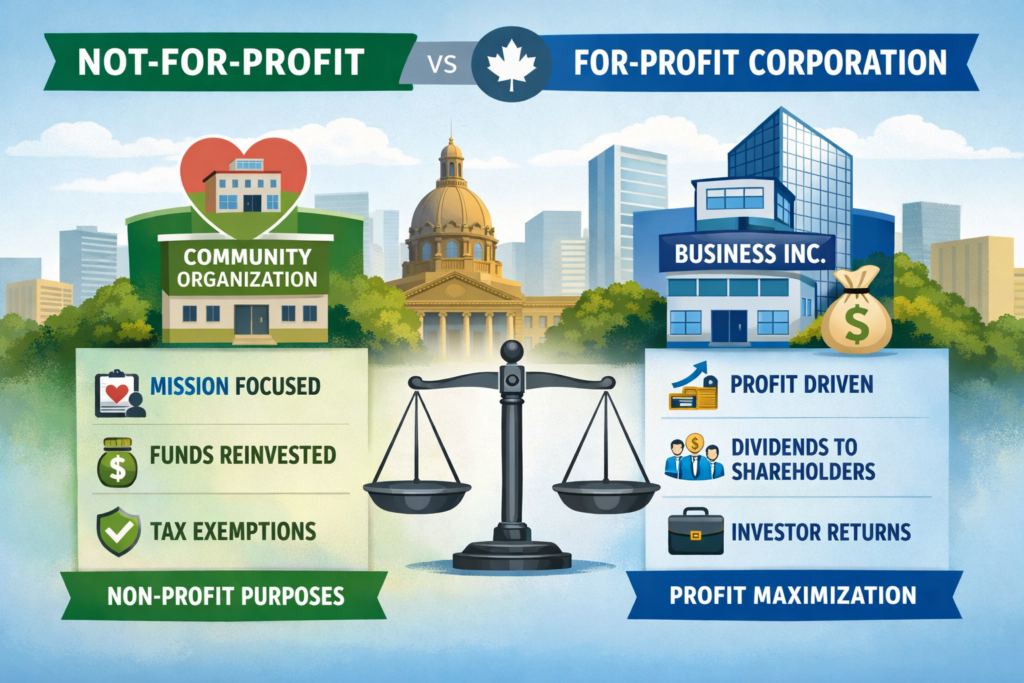
While not-for-profits and for-profit corporations share the same foundational concept of incorporation, they differ in purpose, profit distribution, and governance.
1. Purpose
A for-profit corporation exists primarily to generate profit for its shareholders. A not-for-profit, by contrast, is organized for a non-commercial purpose, such as:
- Charitable or philanthropic activities
- Social, cultural, or community objectives
- Professional, recreational, or trade associations
- Advocacy or public-interest work
In Canada, the law requires that a not-for-profit’s activities align with its stated non-profit purposes.
2. Profit and Distribution
A not-for-profit can earn revenue and even generate a surplus. What it cannot do is distribute profits to members, directors, or officers.
Any surplus must be reinvested into the organization’s purposes. This is one of the defining legal features separating not-for-profits from for-profit corporations, where dividends and shareholder distributions are central.
3. Ownership and Control
For-profit corporations are owned by shareholders. Not-for-profits do not (usually) have shareholders. Instead, they may have members, who typically elect the board of directors and help oversee the organization’s mission. Control is mission-driven rather than equity-driven.
4. Tax Treatment
Not-for-profits may be eligible for certain tax advantages under Canadian tax law, such as income tax exemptions, depending on their activities and structure. Some not-for-profits may also qualify for registered charity status, which brings additional benefits—and additional compliance obligations.
Not all not-for-profits are charities, and not all tax exemptions are automatic. Careful structuring and ongoing compliance are essential.
Why Choose a Not-for-Profit Structure?
A not-for-profit structure may be appropriate where:
- The primary goal is mission-driven, not profit-driven
- Funding will come from grants, donations, membership fees, or public sources
- Public trust, transparency, and accountability are important
- The organization needs legal continuity beyond its founders
- Profit distribution would undermine credibility or legal eligibility for funding
In Alberta and across Canada, many community organizations, industry associations, sports clubs, and advocacy groups rely on the not-for-profit model to operate effectively while maintaining public confidence.
Not the Right Fit for Every Organization
A not-for-profit is not simply a “better” or “cheaper” alternative to a for-profit corporation. It comes with:
- Governance obligations
- Restrictions on how money can be used
- Reporting and compliance requirements
- Limitations on restructuring or winding up assets
For organizations intending to generate profits for founders or investors, a traditional for-profit corporation is usually the more appropriate choice.
Choosing the Right Structure
The decision between a not-for-profit and a for-profit corporation should be made early—and deliberately. The structure you choose affects governance, taxation, fundraising, liability, and long-term flexibility.
Legal advice at the incorporation stage can help ensure that your organization’s structure aligns with its goals, funding model, and legal obligations under Alberta and Canadian law.